At the History Conference preceding the National Nursing Forum 2024, I had the pleasure of presenting on a topic that merges historical artefacts with modern nursing education: Object-Based Learning and Health Humanities in Nursing Education. As part of a panel discussion, I explored how objects found in clinical settings, often overlooked, play a profound role in teaching person-centred care and fostering empathy, critical thinking, and cultural sensitivity among nursing students.
The untold stories of hospital artefacts
In many hospitals, tucked away in nondescript glass cabinets along corridors, sit relics of the past—medical instruments, faded uniforms, and sepia-toned photographs. Some cabinets are immense, while others are modest, almost apologetic in size, but all of them seem to share a peculiar, looming collective silence. These artefacts are arranged, or perhaps simply amassed, by era or by function, as if whispering fragments of a story that never fully forms. At my hospital, two such cabinets stand in a corner, an unassuming archive that most passers-by barely notice. Yet one day, as I drifted past, something caught my eye: a small, delicate bedpan of white porcelain. It looked worlds apart from the bulky green bedpans so ubiquitous in our wards today—its slenderness, its smooth surface, quietly dignified as if it had been plucked from a different time and place entirely.
My curiosity about this little white porcelain bedpan led me to research bedpans’ history. I discovered that bedpans have undergone considerable evolution over time, with diverse designs, functions, and materials tailored for various purposes and settings from home care to hospital use, and designed for either urinary use, bowel movements, or both. In one example of such a collection, a collector in the USA has gathered over 250 different bedpans (Oatman-Stanford, 2014), yet such collections often lack the historical and cultural context that can truly bring these objects to life.
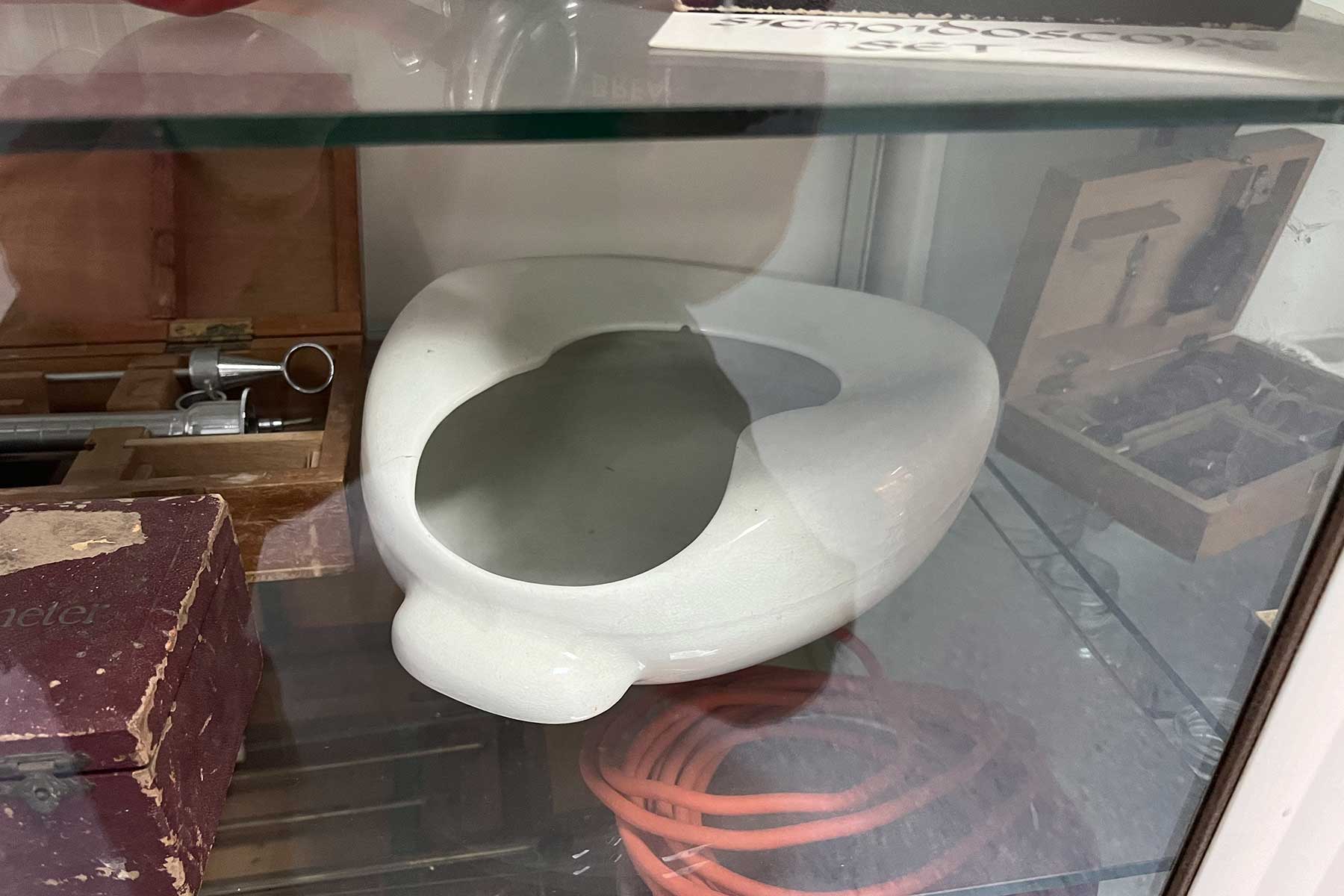
Image: A white porcelain bedpan found at Osborne Park Hospital.
The concept of object-based learning
Object-based learning (OBL) is a dynamic, student-focused teaching approach that encourages in-depth observation, hands-on interaction, and critical analysis of artefacts to uncover their historical, practical, and emotional significance (Chatterjee & Hannan, 2016). In nursing education, OBL encourages students to go beyond textbooks and immerse themselves in the material and sensory experiences associated with healthcare tools and objects (Dodd et al., 2022). Studies highlight OBL’s versatility and its powerful role in promoting inclusivity, making it particularly effective in meeting diverse health humanities education goals for learners of different backgrounds, experience and knowledge levels (Hensel & Moorman, 2017).
Initially centred on traditional art forms such as paintings (Wikstrom, 2000), OBL has expanded to include a wide array of artefacts including sculptures (Nicol & Pocock, 2020), museum collections (Clark et al., 2018), and photo albums (Dodd et al., 2022), enriching the exploration of complex health humanities subjects. This broader scope allows students to connect with these subjects not only visually but also through sensory and tactile experiences. This approach supports nuanced learning, such as understanding dementia as an evolving process rather than a fixed state. For example, the University of Sydney’s use of the artefacts in its pharmacy museum enables first-year pharmacy students to draw meaningful connections between the profession’s past and present practices (Cheung et al., 2022).
Inspired by these advancements, I developed a teaching plan for a 90-minute group workshop that incorporates nursing artefacts commonly found in hospitals as teaching tools into the bachelor nursing curriculum, prompting exploration and reflection on patient experiences and nursing roles that have evolved with changes in technology and societal expectations. This approach emphasises the evolving characteristics and needs of patient demographics, encouraging students to reflect on and re-evaluate the concept of person-centred care.
Historical artefacts as teaching tools for skills and health humanities
The OBL activities in this workshop were designed to build critical skills such as clinical observation, communication, and analytical thinking within a supportive, student-friendly group work environment. These competencies are essential for effective multidisciplinary teamwork and align with the standards set by the Nursing and Midwifery Board of Australia for Registered Nurse Practice.
Using accessible, meaningful objects from clinical settings supports adult learning principles and brings objects to life. For instance, examining bedpans invites students to consider questions that bridge the practical and humanistic aspects of nursing, such as:
- Why specific materials are used to make bedpans?
- What accounts for the variations in bedpan size and design over time?
- How do patients and nursing staff feel about the use of bedpans?
- What changes could improve the experience for both patients and staff?
From historical porcelain models to contemporary plastic or paper ones, students observed, touched, and discussed these items, considering how design choices reflect changes in infection control, comfort, and accessibility. The evolution in bedpan size, shape, design, and materials reflects broader shifts in healthcare values, technology, and patient needs. These explorations not only inspire critical thinking but also encourage students to imagine innovations that could make health care more compassionate and inclusive.
Health humanities deepen the learning experience by encouraging students to consider the emotional impact of healthcare tools and practices on patients and caregivers alike. The OBL learning experience helps students to empathise with patients, an essential component of person-centred care. By reflecting on human dimensions in clinical care, nursing students can better understand the complexities of their profession and are inspired to approach patient interactions with greater compassion.
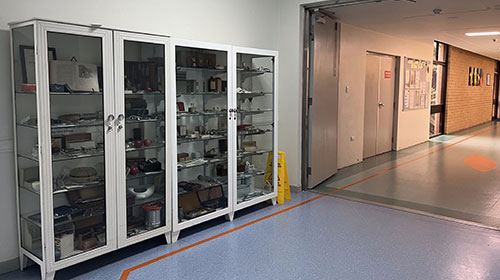
Image: Display cabinet showcasing a collection of vintage and used items at Osborne Park Hospital, located in the hallway.
Conclusion
The presentation underscored the value of incorporating historical and culturally significant objects into nursing curricula to enrich students’ understanding of person-centred care. Object-based learning fosters a deep connection to both the technical and empathetic sides of nursing, empowering students to carry forward a tradition of compassion and respect in their practice. As educators, embracing OBL and health humanities ensures that our future nurses are well-equipped to meet the evolving needs of their patients with empathy and innovation.
This article was originally published in the Autumn 2025 edition of ACN’s quarterly member publication The Hive. Members can access all past editions of The Hive on MyACN. Non-members can get a sneak peek by viewing our open-access articles.
Author: Jade Chen MACN

References
Chatterjee, H. J., & Hannan, L. (2016). Engaging the Senses: Object-Based Learning in Higher Education. Routledge. https://www.google.com.au/books/edition/_/E7K1CwAAQBAJ?hl=en&gbpv=1
Cheung, J., Thoeming, A., Guerry, E., Thogersen, J. I., & Ong, J. (2022, September 16). Pharmacy Students Working with Museum Collections and Artefacts – A Case for Object-Based Learning. Teaching@Sydney; The University of Sydney. https://educational-innovation.sydney.edu.au/teaching@sydney/pharmacy-students-working-with-museum-collections-and-artefacts-a-case-for-object-based-learning/
Clark, Z., Ashbrooke, L., & Price, J. (2018). Creating Meaningful Learning for Children’s Nursing Students: Can Museum Field Trips Offer Added Value? Comprehensive Child and Adolescent Nursing, 42(1), 71–84. https://doi.org/10.1080/24694193.2017.1390008
Dodd, S., Carter, G., Christie, A., & Mitchell, G. (2022). Exploring nurse and nursing student experience of using an artist-produced photobook to learn about dementia. BMC Nursing, 21(1). https://doi.org/10.1186/s12912-022-00991-2
Hensel, D., & Moorman, M. (2017). Doctorate of Nursing Practice Students’ Impressions of Uses for Visual Thinking Strategies. The Journal of Continuing Education in Nursing, 48(8), 365–368. https://doi.org/10.3928/00220124-20170712-08
Nicol, J., & Pocock, M. (2020). Memento Mori: Can art assist student nurses to explore death and dying? A qualitative study. Nurse Education Today, 89, 104404. https://doi.org/10.1016/j.nedt.2020.104404
Oatman-Stanford , H. (2014). World’s Foremost Bedpan Collector Celebrates Objects Most People Pooh-Pooh. Collectors Weekly. https://www.collectorsweekly.com/articles/worlds-foremost-bedpan-collector/
Wikstrom, B.-M. (2000). Nursing Education at an Art Gallery. Journal of Nursing Scholarship, 32(2), 197–199. https://doi.org/10.1111/j.1547-5069.2000.00197.x